
CSSBuy Reverse Purchasing Guide 2026: The Two-Checkout Workflow
A reverse purchase looks simple from the outside: paste a Chinese marketplace link, pay, wait for warehouse photos, and ship the parcel. In practice, the transaction is split across decisions that happen at different times. The product is bought before international freight is known. The warehouse receives evidence before you decide whether the item deserves overseas shipping. The parcel is assembled only after separate domestic orders have become inventory. That gap between purchase and delivery is where most avoidable mistakes occur.
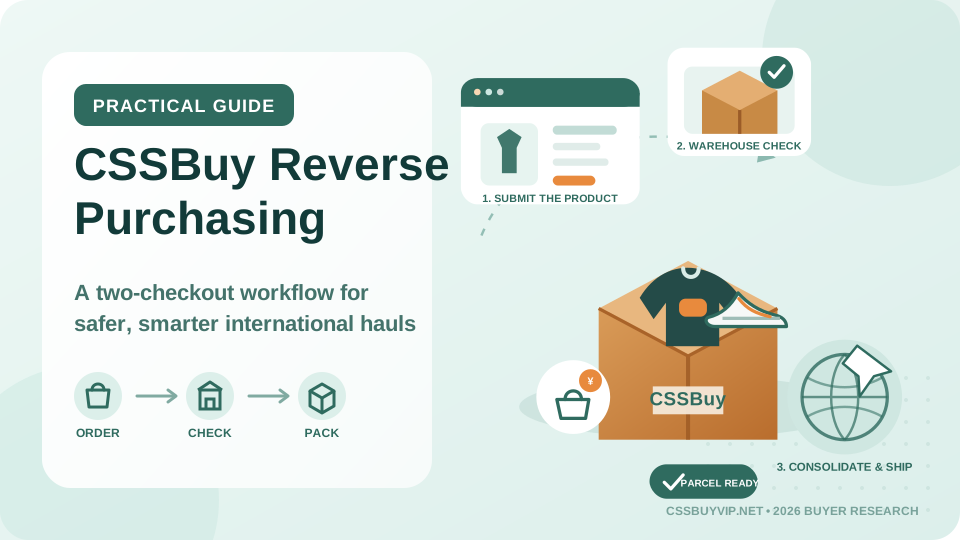
CSSBuy’s current Buy For Me process is built around that separation. Buyers can submit links from major Chinese platforms, search selected marketplaces inside CSSBuy, or manually enter product information when an ordinary link cannot be read. The first payment covers the item and Chinese domestic delivery. After CSSBuy purchases the order, the seller sends it to the warehouse for inspection and storage. The buyer later selects stored items, chooses a route and packing services, and pays an international shipping deposit. Treating those stages as one checkout creates confusion. Treating them as a controlled workflow makes reverse purchasing easier to manage.
The Two-Checkout Rule
The most useful mental model is not “buy and ship.” It is “acquire, verify, release.” Acquisition is the domestic transaction. Verification happens while the item is still in China. Release is the decision to place verified inventory into an international parcel.
At the first checkout, confirm the listing, variant, quantity, seller price, domestic freight, minimum order quantity and any restrictions shown by the marketplace or CSSBuy. At the second checkout, decide which stored items belong together, which route can accept them, which packing options reduce risk, and whether the final parcel still makes financial sense.
This prevents a common budgeting error. The product price is not the delivered price. A cheap item may become inefficient when it is bulky, restricted, fragile or shipped alone. Several moderate purchases can be more economical when consolidated into a planned parcel.
Create an Order Passport Before Payment
Every order should carry a short “passport”: a compact record of the facts that must survive the journey from seller page to warehouse shelf.
Record the original title, selected color, size, model, quantity, seller price, domestic delivery charge and expected accessories. Save important measurements and screenshots because seller pages can change after payment. For 1688 orders, also record the supplier’s minimum order quantity and whether the price changes with volume. CSSBuy warns that many 1688 products have minimum quantities and that these purchases follow a different quality-control standard.
Add one sentence explaining what would make the order unacceptable. Examples include “must include the detachable strap,” “EU plug required,” or “chest width should be close to 58 centimeters.” A purchasing note should identify decisive facts, not describe every preference.
Use the Submission Method That Preserves Information
CSSBuy currently lets buyers paste a product link, search by product name across supported marketplaces, or enter product information manually. The official workflow lists sources including Taobao, Tmall, JD, 1688, Yupoo and WeChat. When an ordinary search does not resolve the item, CSSBuy directs buyers toward Expert Buy.
Choose the method that preserves the most accurate information. An automatically parsed listing is useful only when its options and price are correct. If it loads the wrong variant, hides a seller instruction or misses domestic freight, manual entry can be safer. Before paying, read the cart as though another person will use it without seeing the original page. If the order would be ambiguous to a purchasing agent, it is not ready.
Keep Communication Attached to the Order
CSSBuy allows buyers to add a note during purchasing, and the platform may contact the buyer when information is missing. Use order-level communication instead of scattered personal messages.
A good note is specific and answerable. “Please ask whether the bag includes both straps” is actionable. “Please make sure everything is perfect” is not. When the seller replies, copy the important result into your order passport. If a seller agrees to a different price, size or combination, verify that the payable order reflects that agreement. The warehouse can inspect what arrives, but it cannot reconstruct an undocumented conversation.
Treat Warehouse Arrival as a Deadline
Once an item reaches the CSSBuy warehouse, the next clock starts. CSSBuy states that warehouse staff inspect goods and provide photos. Its public return conditions generally require the seller to accept the return, the item to have been in the warehouse for fewer than seven days, and the buyer to pay return shipping. Exact eligibility depends on the order and seller, but the practical message is clear: review quickly.
CSSBuy also publishes 90 days of free storage beginning when an order is marked “In Warehouse.” Current public information says storage can be extended for 15 yuan per order per month after the free period. Items that pass the deadline without shipment or an extension may be treated as abandoned and destroyed. The 90 days are a consolidation buffer, not a reason to delay inspection. The return opportunity is usually much shorter.
Review each arrival against its passport. Confirm identity first: correct item, variant, size and quantity. Then check visible condition and included parts. Finally decide whether uncertainty is important enough to request more evidence.
Separate “Accepted” From “Ready to Ship”
An item can pass inspection but still not be ready for a parcel. A winter coat may wait for other seasonal pieces. A fragile collectible may require a compatible packing plan. A battery-powered product may face route limitations. Use two statuses in your tracking sheet: “QC accepted” and “parcel assigned.”
This prevents accidental shipment. Buyers often submit everything currently stored because consolidation is convenient. A better process assigns each item to a parcel only after checking category restrictions, dimensions, estimated weight and destination rules.
CSSBuy states that some products are restricted to certain delivery methods and that recommended options are shown during parcel submission. Route compatibility should influence purchasing before the warehouse fills up, not after every item has arrived.
Build Parcels Around Compatibility
CSSBuy’s Ship For Me materials describe combining separate warehouse packages into one outbound parcel. Consolidation can reduce repeated base charges, but combining everything is not automatically efficient.
Group items by compatible risk. Soft clothing can share a volume-reduction strategy. Rigid shoes, structured bags and boxed collectibles may need shape protection. Liquids, batteries, magnets, fragrances and other sensitive categories can force a different route or separate parcel. Ask three questions before merging orders: Can every item use the same route? Can one packing plan protect all of them? Would one problematic item make the entire parcel slower, more expensive or less insurable? If the last answer is yes, splitting may be smarter.
Choose Packing Services by Failure Mode
CSSBuy lists services such as packaging removal, reinforced packaging, vacuum packaging, label cutting and insurance. Each option should answer a specific risk.
Packaging removal can reduce volume but may remove structural support. Vacuum packing suits compressible clothing but can crease structured garments. Reinforcement can protect fragile goods while adding size and weight. Label cutting is a handling request, not protection from customs inspection. Insurance only helps within its current terms and exclusions.
Write outcome-based instructions. “Remove external shoe boxes but keep accessories in labeled bags” is clearer than “make parcel smaller.” “Protect the bag’s shape and reinforce outer corners” is clearer than “pack well.”
Understand the Shipping Deposit
During international submission, CSSBuy calculates a shipping deposit using estimated weight, selected method and destination. The final logistics charge is determined after parcel size and weight are verified. CSSBuy states that any difference between the deposit and final fee is reconciled through the buyer’s account after shipment.
Leave a budget margin instead of spending the entire balance on products. Compare routes using more than the headline price: category acceptance, delivery expectations, tracking, insurance availability, volumetric rules and destination conditions all matter.
After dispatch, CSSBuy directs buyers to track the shipment through My Parcel and use the parcel note function for support. Keep the parcel number, packing requests, paid deposit and final adjustment in the same ledger as the original orders.
A Practical Release Checklist
Before the domestic order, confirm the exact link or manual entry, variant, quantity, price, domestic freight, seller conditions and minimum quantity. Save listing evidence and write one decisive note.
After warehouse arrival, compare the item with its passport immediately. Resolve wrong variants, missing parts, damage and measurement questions before the applicable return opportunity closes.
Before parcel submission, include only accepted items. Check route compatibility, packing requirements, storage age and the realistic delivered budget. Separate sensitive or disruptive products when they weaken the whole parcel.
After shipping, record the final weight, final charge, tracking status and account adjustment. Your own parcel history will make future estimates more useful than generic assumptions.
Frequently Asked Questions
Does CSSBuy buy directly from Chinese sellers for me?
Yes. Under Buy For Me, the buyer submits the product and pays for the item plus Chinese domestic delivery, then CSSBuy contacts the seller and places the purchase.
Can I submit an item that does not parse correctly?
Yes. CSSBuy provides manual product entry and an Expert Buy option for products that cannot be handled through the normal search or link process.
When should I check warehouse photos?
As soon as the order is marked in the warehouse. Storage may last much longer than the seller return opportunity, so waiting for the entire haul can remove useful options.
How long is free storage?
CSSBuy currently states that ordinary warehouse orders receive 90 days of free storage from the “In Warehouse” status. Its public Q&A also lists a 15 yuan per order monthly extension after that period. Check the live account rules before relying on an extension.
Does consolidation always reduce shipping cost?
No. It may reduce duplicated base charges, but incompatible routes, volumetric weight, fragile goods or sensitive items can make separate parcels more practical.
Is the international shipping deposit final?
Not always. CSSBuy calculates the deposit from estimated weight, route and destination. The final amount is based on verified parcel size and weight, with the difference reconciled through the account.
What is the most important reverse-purchasing habit?
Maintain one order passport from link submission through delivery. When product facts, seller messages, warehouse evidence and parcel records stay connected, errors are easier to detect while they are still inexpensive to fix.
Editorial note: This guide was fact-checked against CSSBuy’s official Buy For Me, Ship For Me, About, service and public Q&A materials on August 5, 2026. Platform policies, fees, route availability, return conditions and storage rules can change, so buyers should verify the live order and parcel interfaces before paying.