
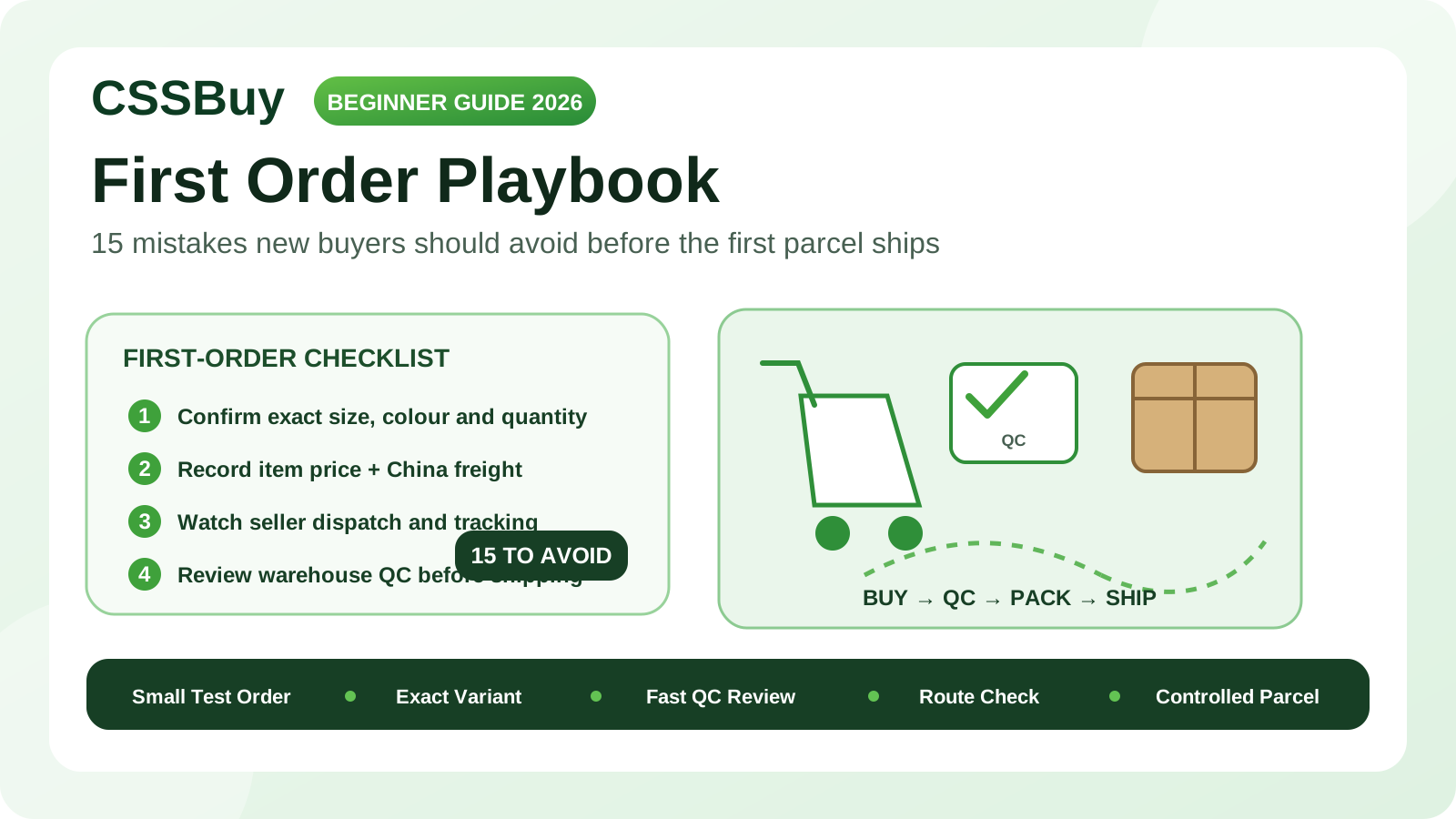
CSSBuy First Order Guide 2026: 15 Mistakes New Buyers Should Avoid
A first CSSBuy order is easy to start and surprisingly easy to overcomplicate. New buyers often focus on finding the cheapest listing and treat everything after checkout as routine. CSSBuy’s current public workflow shows the opposite: the purchase is a chain of decisions. You choose or submit an item, pay for the product and Chinese domestic delivery, CSSBuy places the order, the seller ships to the warehouse, the warehouse checks and stores it, and only then do you build an international parcel.
That sequence gives beginners several chances to prevent expensive mistakes, but only if they make the right decision before each handoff. The goal of a first order should not be to build the biggest haul. It should be to learn the process with a purchase that is simple enough to control.
Below are fifteen mistakes worth avoiding on your first CSSBuy order.
Mistake 1: Starting with a large haul
The fastest way to make a first order confusing is to buy from many sellers at once. Every seller creates another domestic shipment, another stock risk and another warehouse arrival time. If one item is delayed, the entire plan becomes harder to read.
Start with a small test order. Choose a few ordinary items from one or two sellers. A small order lets you learn how payment, purchasing, domestic tracking, QC and parcel submission actually look inside your account before more money is committed.
Mistake 2: Treating the listing price as the total cost
The seller’s price is only the first number. CSSBuy’s Buy For Me flow separates the domestic purchase from international shipping. At the first stage, you pay for the item and Chinese local delivery. International shipping comes later after the goods reach the warehouse and a parcel is created.
Record the item price and domestic freight before checkout. Then keep a separate international-shipping reserve. A low seller price can become poor value if the item is bulky, restricted to expensive routes or packed in a way that creates high volumetric weight.
Mistake 3: Buying before confirming the exact variant
A product page can contain several colours, sizes, versions or batches. Never assume the picture at the top of the listing is the exact variation in your cart.
Write the selected colour, size, model and quantity into your own order record. For manual orders, make the note explicit enough that another person could place the order without guessing. If you would reject a substitution, say so before the seller reports an out-of-stock option.
Mistake 4: Ignoring seller preparation time
CSSBuy currently says it usually handles paid orders within 24 hours, excluding holidays. That is the agent-handling stage, not a guarantee that the seller will dispatch in 24 hours.
Check whether the seller describes the product as ready stock, preorder, made to order or batch production. A first-time buyer should avoid building a time-sensitive haul around products with unclear preparation periods. If timing matters, ask for a seller dispatch estimate before assuming the item will reach the warehouse quickly.
Mistake 5: Using a difficult private seller for the first test
CSSBuy supports standard marketplace purchasing and also provides Expert Buy for links or sellers that cannot be handled normally. That flexibility is useful, but a first order is not the best time to learn every exception at once.
For your first transaction, prefer a straightforward marketplace listing with clear product options, price and seller information. Save Yupoo, WeChat or complex manual-order situations for later unless the product is unavailable elsewhere. Fewer unknowns make it easier to understand which part of the process caused a problem.
Mistake 6: Forgetting Chinese domestic shipping
Two sellers can offer the same item price while producing different warehouse costs because domestic freight is different. If you buy from several sellers, each can create a separate Chinese delivery charge.
Before paying, write down the domestic shipping amount for each order. If the charge is unclear or changes during purchasing, decide whether the revised total still makes sense. Do not compare sellers only by the headline product price.
Mistake 7: Treating payment as proof the seller has shipped
Paying CSSBuy allows the purchasing process to begin. It does not prove the seller has stock in hand, packed the item or given it to a courier.
Watch the order in stages. First confirm CSSBuy has placed the purchase. Then look for seller dispatch and domestic tracking. A tracking number is useful, but actual carrier movement is better evidence than a label alone. This keeps normal waiting separate from a seller that has not handed over the goods.
Mistake 8: Failing to use Add Note precisely
CSSBuy’s current service page directs purchasing, shipment verification, return and refund questions to the relevant order in My Order through Add Note. The tool works best when the question is specific.
Avoid messages such as “Where is my order?” Include the order number, last verified event and desired action. For example: “The item was purchased four days ago and there is no domestic tracking. Please confirm whether the seller has stock and whether a dispatch date has been provided.” A complete question is easier to investigate.
Mistake 9: Approving warehouse photos too quickly
When the item reaches the warehouse, the process changes from seller progress to buyer verification. CSSBuy’s public pages describe warehouse quality inspection and photos, and current product pages list checks such as style, quantity, colour, size, model and visible damage.
Do not approve the item because the first photo looks roughly correct. Compare it with your original order record. Check the variant, labels, quantity, visible condition and any detail that would make the product unusable for you. If an important feature is not visible, resolve it before international shipping.
Mistake 10: Waiting too long to decide on a return
CSSBuy’s public Q&A says eligible returns require, among other conditions, that the item has been in the warehouse for less than seven days, that the seller accepts the return and that the return shipping fee is paid. That means warehouse arrival starts a decision window.
Review QC soon after the status changes to In Warehouse. Do not treat the warehouse as a place where a questionable item can sit for weeks while you decide. The earlier you identify a mismatch, the more options you are likely to preserve.
Mistake 11: Assuming all goods have identical storage rules
CSSBuy currently advertises 90 days of free storage for ordinary items, while current product pages can distinguish shorter free storage for sensitive goods. The safest habit is to read the live storage information attached to the actual item and order.
For a first haul, create a target ship date long before the maximum storage deadline. Free storage should provide flexibility for consolidation, not become a reason to leave the order unmanaged.
Mistake 12: Buying restricted goods before checking shipping options
CSSBuy’s current cost calculator asks for commodity attributes such as electric goods, liquids, knives, powders, batteries, cosmetics, magnetic products, perfume and other categories because route eligibility can change with product type.
A beginner mistake is to discover this only after purchase. Before buying a sensitive item, run a realistic route check for your destination. One restricted product can reduce the shipping choices for an entire combined parcel, so it may need to be shipped separately.
Mistake 13: Keeping packaging without deciding whether it has value
Retail packaging can protect an item, but it can also add weight and volume. CSSBuy offers services such as package consolidation and vacuum packaging, and its shipping calculator uses both weight and volume inputs.
Classify packaging before parcel submission. If the box is part of the product’s value, keep it. If it is disposable and bulky, consider whether removing it makes sense. Do not request aggressive volume reduction for a collectible package and then expect the box to arrive pristine.
Mistake 14: Choosing the cheapest route by price alone
The cheapest visible shipping line is not automatically the best choice. Route limits, product attributes, weight calculation, delivery characteristics and destination all matter.
Compare at least three factors: whether the line accepts the goods, how chargeable weight is calculated and whether the route characteristics fit the importance of the shipment. For a first parcel, a simple and well-understood line is often more useful than chasing the absolute lowest estimate.
Mistake 15: Shipping before the order record is complete
Before submitting the first international parcel, reconcile every warehouse item against the original purchase. Confirm which items are included, which packaging choices you want, whether any product has unresolved QC, and whether the route accepts every commodity attribute in the parcel.
Once international shipping begins, seller-side corrections become much harder. The best time to fix a wrong colour, missing unit or damaged product is while the item is still in the warehouse, not after it crosses a border.
Build a first-order control sheet
A first order becomes much easier when you track a small set of facts. Keep one row per item with the seller, product link, variation, quantity, item price, domestic freight, payment date, purchase date, seller dispatch date, warehouse arrival date, QC result and planned parcel.
Add one final column called “next action.” It should contain something concrete: wait for seller dispatch, review QC tonight, request a measurement, return before the deadline, compare routes or submit parcel. If the column is blank, you probably do not know what you are waiting for.
The objective is not to turn shopping into paperwork. It is to stop the same decision from being made twice with different information.
A safer first-order sequence
For a beginner, the strongest sequence is simple. Research one or two sellers. Save the exact variation and total domestic cost. Pay only after the instruction is clear. Watch for CSSBuy’s purchase confirmation. Follow domestic tracking instead of the calendar alone. Review warehouse photos promptly. Resolve returns while the window is still open. Check route eligibility before packing. Submit a small parcel. Then audit what happened and improve the second order.
CSSBuy connects several stages that would otherwise require separate Chinese marketplace access, seller communication, warehouse handling and international logistics. That convenience does not remove the buyer’s decisions. It makes the handoffs visible.
Your first order does not need to be perfect. It needs to be controlled. If you can explain what was bought, what it cost to reach the warehouse, what the QC showed, why the items belong in one parcel and why the selected route fits them, you have already learned the part that matters most. The next haul can be larger because the process is no longer new.